In the days between the Nativity and Theophany, the Church places before us figures who do not shine with immediate brilliance. The angels have fallen silent. The cave has emptied. Christ remains with us—but hidden.
It is in this quiet space that the Church remembers the New Martyrs: men and women who lived long after the age of persecutions we like to imagine as distant and safely concluded. Their witness reminds us that the question of faith is not confined to history. It is present. It is costly. And it is often lived without spectacle.
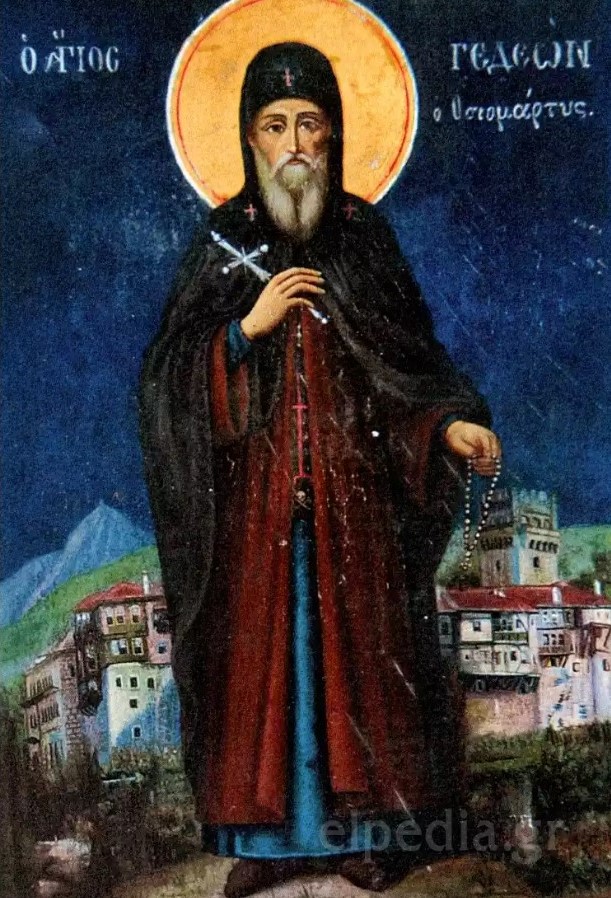
Among them, St Gideon the New Martyr of Mount Athos stands as a particularly sober and merciful figure.
A Saint Who Returned
St Gideon was a monk of Mount Athos who, under pressure and fear, fell away from Christ. Outwardly, he renounced the faith. Inwardly, he was torn apart.
The Church does not hide this. Nor does she excuse it away. Gideon’s story is not honoured because he was flawless, but because he repented.
Consumed by sorrow, he returned openly to the faith he had denied. He did not attempt to justify himself, nor to soften the truth of what he had done. Knowing full well the cost, he confessed Christ publicly and accepted martyrdom in Constantinople in 1818.
What sanctifies Gideon is not the fall, nor even the suffering—but the courage to return to Christ when Christ had become dangerous to name.
Faith When Christ Is No Longer Safe
This matters profoundly in the days after the Nativity.
The Incarnation proclaims that God is with us. But it does not promise that this nearness will always be easy to carry. Christ remains present even when acknowledging Him becomes uncomfortable, inconvenient, or frightening.
St Gideon teaches us that repentance is not a retreat into shame, but a movement toward truth. His return was not dramatic. It was quiet, resolute, and final.
In him we see that the hidden Christ still waits for us—not with accusation, but with mercy.
A Personal Reckoning
There was a time in my own life when I drifted—not away from belief, but away from the life of the Church in a way that still weighs on me.
As a catechumen, I met weekly with Father Antonios, who gave his time freely and generously. Those meetings were an anchor. A place of clarity and grounding. A place where faith was gently ordered and nourished.
Then, slowly, things of the world began to press in.
Friends were suffering—deeply. Several were suicidal. Some died from disease. Others were caught in cycles of abuse and betrayal. It seemed, all at once, that everyone I loved was breaking, and that they all came to me for help.
I did what I could. I had to. I also had to hold myself together for my partner and my family. My own mental health suffered under the strain.
Somewhere in the midst of all this, the weekly meetings with Father Antonios fell away.
I missed them. I missed them as deserts miss the rain.
But I did not feel fit to face him.
In hindsight, this is utterly ridiculous.
My Father—my dear Father Antonios—is perhaps the one human being who could have helped me see clearly, who could have steadied me and returned me to the path with gentleness and wisdom. Yet pride, exhaustion, and a misplaced sense of unworthiness kept me away.
Only now do I see that those trials were necessary. God allowed them. They shaped me in ways I could not have chosen. My heart knows this. My head, however, still reproaches me for lacking the humility to open myself fully to my Father when I most needed to.
Gideon’s Mercy to the Hesitant
This is why St Gideon matters to me.
He does not excuse withdrawal, but neither does he imprison us in it. He stands as a witness that returning—however late, however wounded—is always possible.
Gideon did not delay because he was worthy.
He returned because Christ remained.
The hidden Christ did not withdraw His mercy when Gideon fell. He waited.
Between Fear and Revelation
As we move toward Theophany, the Church teaches us that revelation comes not to those who never falter, but to those who remain honest before God.
Christ will soon step into the Jordan. Heaven will open. The Spirit will descend. The Son will be named.
But before that, we are given this quiet day, and this quiet saint, who tells us that faith is not proven by uninterrupted strength—but by repentance grounded in trust.
The Christ who hid Himself in the cave is the same Christ who waits for us when we turn back toward Him.
And He is with us still.
 Epektasis
Leave a comment