
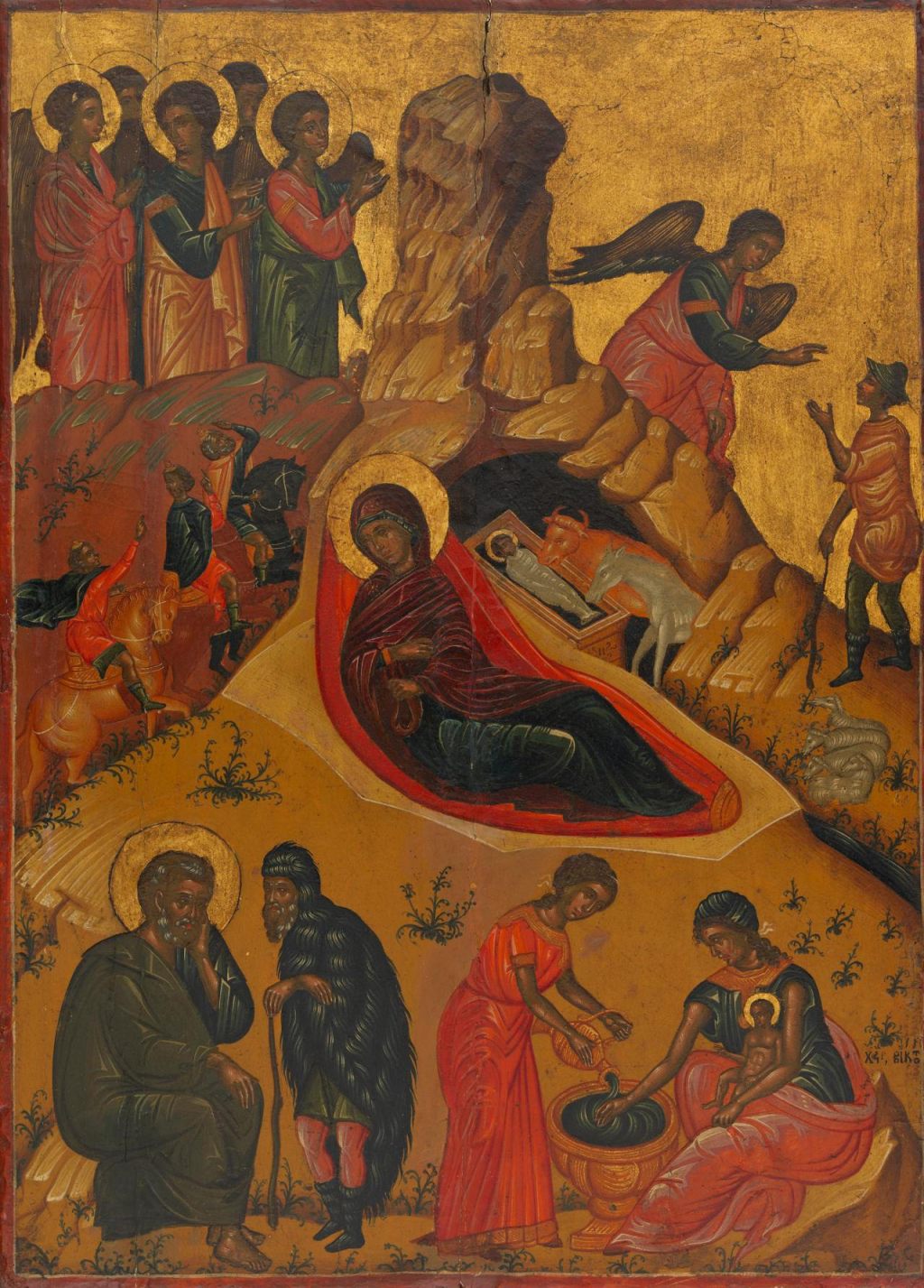
The Church does not linger sentimentally at the manger.
Barely has the joy of the Nativity begun when, on December 27th, she places before us St Stephen the Protomartyr. The Child has scarcely been laid in the cave, and already we are shown the cost of loving Him. This is not to dampen our joy, but to deepen it—to teach us that the Incarnation is not an idea to be admired, but a life to be lived.
Stephen stands as the first witness that light, when it enters the world, is not always welcomed.
“I see the heavens opened, and the Son of Man standing at the right hand of God.”
— Acts 7:56
Stephen sees what others cannot—or will not. And for this sight, he is stoned.
The First Witness After the Feast
It is no accident that Stephen follows immediately after Christmas. The Church is precise in her wisdom. She teaches us that the joy of Christ’s birth cannot be separated from the reality of His rejection. The same world that bent low toward the coming Light now hardens itself against it.
Stephen does not die because he is aggressive or defiant. He dies because he will not look away. His martyrdom is not dramatic in the way the world understands drama. It is quiet, prayerful, forgiving.
“Lord, do not hold this sin against them.”
— Acts 7:60
This is the first echo of the Cross. The Child in the cave already casts its shadow.
Faith Is Not Formed Quickly
Stephen’s witness reminds me that faith is not something acquired suddenly, nor mastered through intensity or effort. It is shaped—slowly, patiently, often invisibly—through fidelity, love, and endurance.
This has been one of the hardest lessons of my own journey.
I have always wanted clarity. Progress. Assurance. I have wanted faith to feel like something solid, something accomplished. But Orthodoxy has taught me—often through failure and humility—that faith is not forged in certainty, but in remaining, even when certainty feels distant.
The long, slow shaping of faith is not glamorous. It does not announce itself. It is often marked by doubt, by spiritual dryness, by seasons of silence, and by our own inability to live up to what we believe.
And yet, this is precisely where God works.
The Gift of a Spiritual Father
In reflecting on St Stephen’s steadfastness, I cannot help but give thanks for my own spiritual father, Father Antonios.
His kindness toward me—and toward so many catechumens—has been beyond compare. Even when exhausted, he has always made time. Even when we stumble, question, doubt, or disappear entirely, he remains present. There is no keeping score. No rebuke disguised as concern. No demand for performance.
There is simply patience.
There have been moments of spiritual crisis, of deep questioning, of stepping back when things felt overwhelming or unclear. Moments when I assumed forgiveness would be required, explanations demanded. Instead, I was met with understanding so whole-hearted that it disarmed me entirely.
Forgiveness not required.
This, too, is a form of witness.
“Nothing so attracts the grace of the Spirit as humility.”
— St Isaac the Syrian
Through Father Antonios, I have come to see that spiritual fatherhood is not about control or correction, but about remaining steadfast when others falter. His love reflects something of Stephen’s spirit: a refusal to abandon, a commitment to love without condition, a faith that endures quietly.
Witness Is Often Hidden
Stephen was a deacon. He served tables. He cared for others. His martyrdom did not erase the ordinary faithfulness that preceded it; it revealed it.
Likewise, the shaping of faith often happens not in moments of triumph, but in the quiet persistence of love—in priests who continue to show up, in communities that wait without pressure, in God who does not withdraw when we do.
This is the kind of witness that follows the Nativity.
Not fireworks. Not certainty. But love that does not leave.
From the Cave, Into the World
The Church places Stephen before us now to teach us that Christ is born not to preserve us from difficulty, but to accompany us through it. The Incarnation is God’s commitment to remain with us—patiently, faithfully, unto the end.
If the Nativity reveals God’s humility, Stephen reveals what that humility looks like when lived.
May we learn, slowly and imperfectly, to remain.
Closing Prayer
Holy Protomartyr Stephen,
first witness of the Incarnate Christ,
teach us to see the heavens opened
even when the world resists the Light.
Pray for us, that our faith may be shaped
not by haste or fear,
but by patience, humility, and love.
Strengthen those who guide us,
those who remain when we falter,
and those who quietly bear the weight of others.
May we learn to remain faithful,
trusting that God is at work
even in the long and hidden seasons.
Amen.

 Epektasis
Leave a comment