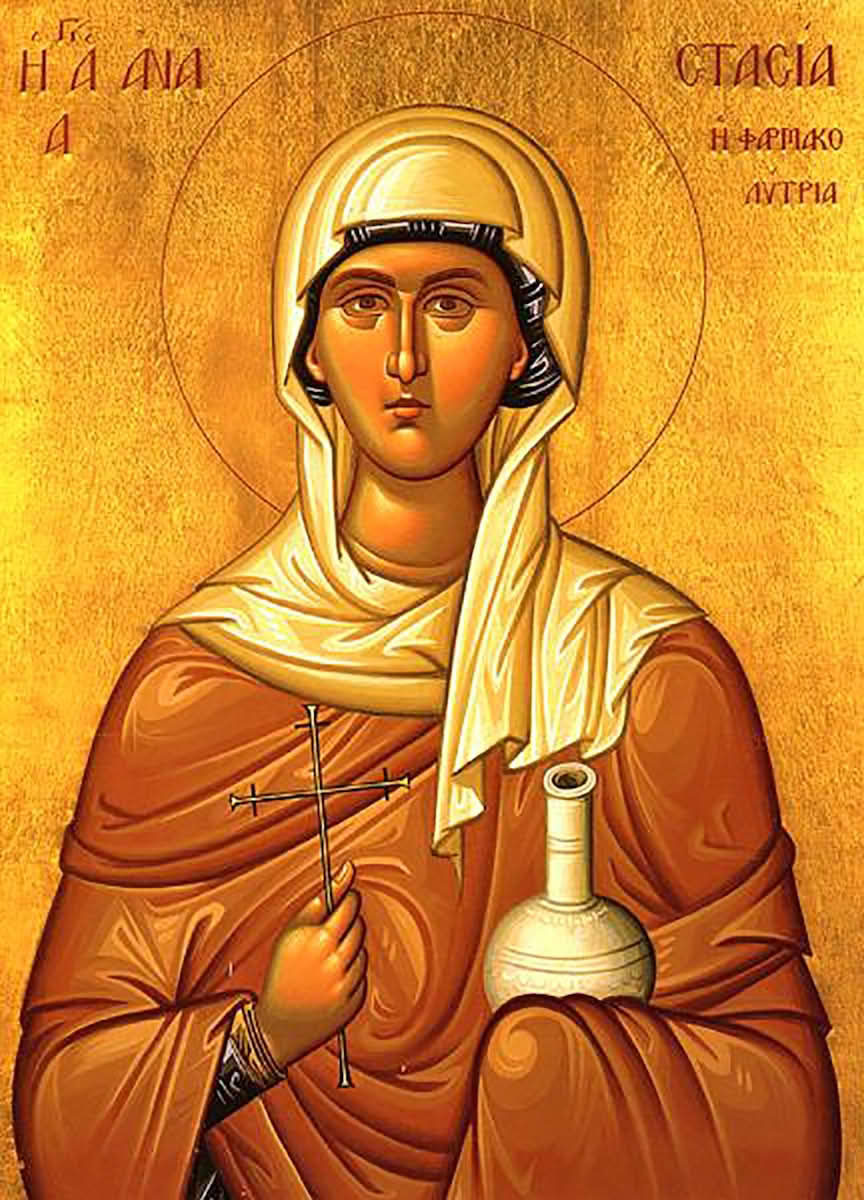
On Saint Anastasia the Great Martyr
There is a quiet temptation that follows many of us through adult life: the fear that we are not doing enough.
Not enough for God.
Not enough for the world.
Not enough for those who suffer, or for the beauty and life entrusted to us.
We measure our days by outcomes and achievements, by visible change and tangible results. When these are lacking—when work feels repetitive or fruitless, when our efforts seem swallowed by systems larger than ourselves—we begin to wonder whether our lives are, in some essential way, failing.
It is into this unease that the Church places before us today Saint Anastasia the Great Martyr.
A Saint Who Did Not Change the World
Saint Anastasia did not overthrow prisons.
She did not dismantle persecution.
She did not end suffering.
She went into the prisons.
Born into wealth and position, living outwardly unremarkable years, she quietly used what she had—time, resources, courage—to visit those condemned for Christ. She brought food, medicine, and comfort. She listened. She stayed. She returned.
Again and again.
What she offered was not deliverance from death, but presence within it.
The Gospels do not glorify effectiveness. They glorify fidelity.
Christ Himself tells us that the final judgment turns not on success, but on attention:
“I was hungry and you gave Me food, I was thirsty and you gave Me drink, I was a stranger and you welcomed Me, I was sick and you visited Me, I was in prison and you came to Me.”
(Matthew 25:35–36)
Saint Anastasia did precisely this—and nothing more.
And it was enough.
The Weight of Small Faithfulness
There is something deeply consoling, and deeply unsettling, about saints like Anastasia. They remove our excuses, but they also remove our despair.
She did not wait until she could fix suffering to respond to it. She did not demand meaning from her circumstances before acting. She simply went where love was needed, again and again, until her life was entirely given.
St. John Chrysostom reminds us that Christ does not demand greatness from us, but love:
“Do you wish to honor the Body of Christ? Do not neglect Him when you see Him naked. Do not honor Him here in the church with silken garments while neglecting Him outside where He is cold and naked.”
Saint Anastasia honored Christ where He was hidden—behind bars, in illness, in fear.
Her greatness was not dramatic. It was accumulative.
Presence as Participation in Christ
In a world that prizes solutions, the Orthodox tradition insists on something more difficult: remaining.
Christ does not stand at a distance from human suffering. He enters it. He abides in it. He remains faithful unto death.
St. Maximus the Confessor writes:
“The Word of God became man so that man might learn from Him how to suffer with love.”
Saint Anastasia learned this lesson well. She did not explain suffering away. She did not conquer it. She bore it with others.
This is not passivity. It is participation.
To be present—to refuse to turn away, to stay attentive, to love without guarantee of success—is to take part in the life of Christ Himself.
When Life Feels Small
There are seasons when our lives feel painfully narrow. Work feels repetitive. Days pass without visible fruit. We wonder whether anything we do matters beyond survival.
Saint Anastasia answers this anxiety not with reassurance, but with witness.
She shows us that usefulness in the Kingdom of God is not measured by scale, but by faithfulness. Not by transformation of systems, but by love that refuses to withdraw.
St. Gregory of Nyssa reminds us:
“The one who runs toward the Lord never ceases to grow.”
Growth does not always look like movement forward. Sometimes it looks like remaining where love has placed us, and learning to be present there with attention and humility.
Resurrection Hidden in Faithfulness
The name Anastasia means Resurrection.
And yet, her life unfolded among prisoners and martyrs, sickness and death. Resurrection did not appear as triumph, but as quiet endurance infused with love.
This is the paradox the Church offers us again and again: that resurrection begins long before death, in the daily choice to remain present to Christ in whatever form He appears.
St. Isaac the Syrian writes:
“Do not call God just, for His justice is not manifest in the things concerning you.”
God’s economy is not ours. The smallest acts, done in love, are never lost. They are gathered into the infinite life of God, where nothing faithful is wasted.
Learning to Stay
Saint Anastasia does not call us all to martyrdom. She calls us to attention.
To stay.
To visit.
To tend.
To love without certainty.
In a world anxious for impact, she reminds us that presence itself is a form of witness. That even lives which feel ordinary, constrained, or unfinished can become places where Christ is quietly met and served.
This is not a consolation prize. It is the shape of the Gospel.
And it is more than enough.
 Epektasis
Leave a comment